A store-wide sale puts tens of thousands of products on a new price. For any retailer managing that with paper labels, the same five problems show up — and they compound.
A dedicated staff member — full time, full salary — doing nothing but printing, sorting, and sticking price tags. That's a person who could be helping customers, driving sales, or managing inventory. Instead, they're peeling adhesive backings.
$35K / year · one full-time positionPrice tag runs monopolize shared printers that the rest of the business needs for invoices, shipping manifests, and customer paperwork. Printer contracts, toner costs, maintenance calls, and outages cascade across every department — not just pricing.
Every outage affects the whole operationA sale ends. Tags get missed. Customers bring items to the register expecting the old price. In Canada, the Scanner Price Accuracy Code means items under $10 go free and items over $10 get a $10 reduction. Every stale tag is money walking out the door — and a frustrated customer with it.
69% mismatch rate at independent retailersSpecialty adhesive label stock, branded tag paper, thermal ribbons, ink cartridges, printer maintenance. Custom stock printed with the wrong logo? Dozens of reams in the garbage. The wrong size? Same. These costs never stop — and neither does the landfill contribution.
$15K / year · paper, ink, contracts, wastePeeling labels, adhesive residue on shelf edges, mismatched tag styles across aisles. For any retailer where presentation matters, paper labels undermine the shopping experience. The shelf is part of the product.
Residue, peel marks, mismatched brandingThe enterprise ESL market starts at $250,000+ for a deployment, requires ongoing cloud subscriptions, and routes pricing data through overseas servers. For a single-location retailer with 1,000 tags, that market simply didn't have an offering.
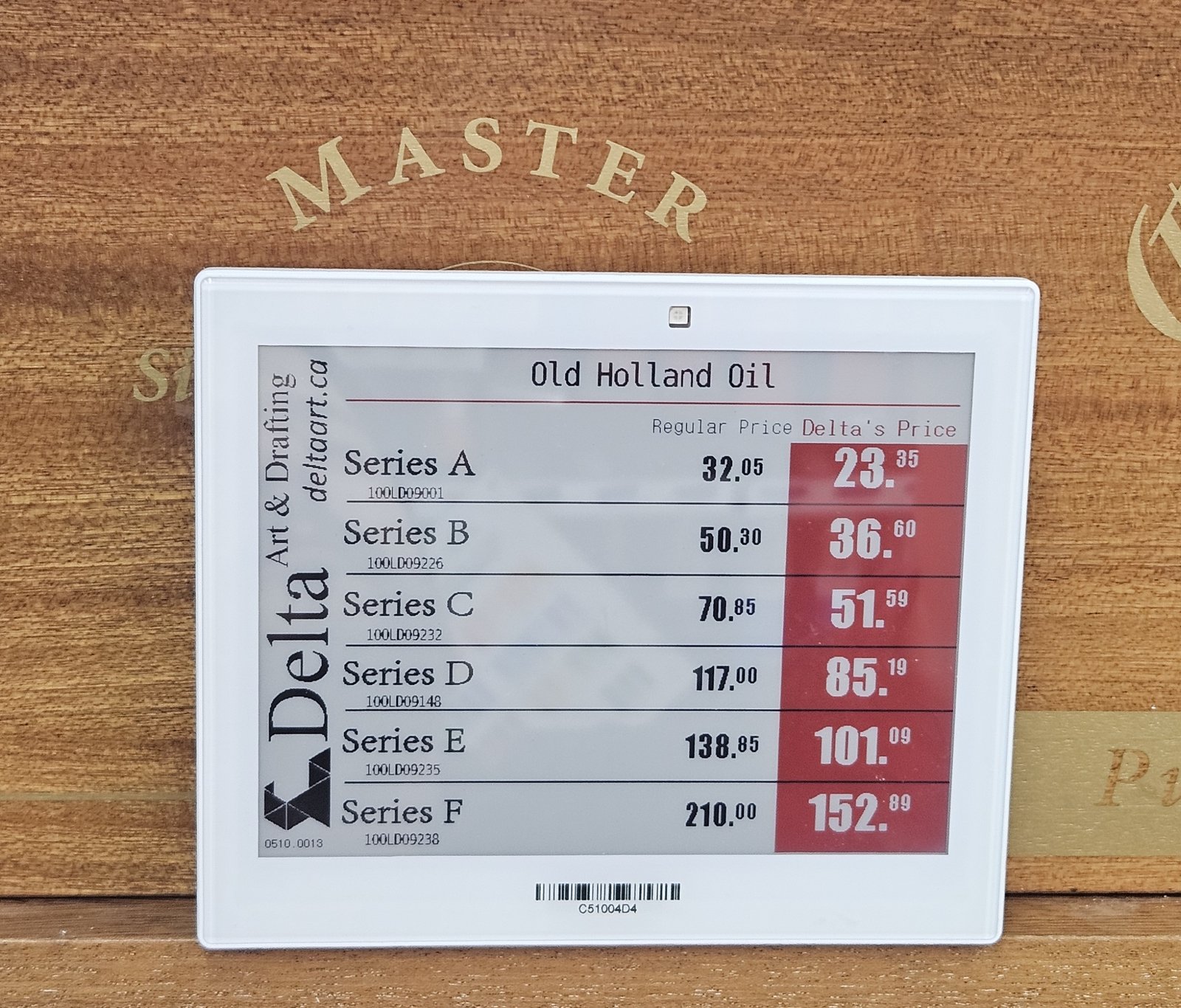
$250K+ minimum · cloud-locked · data offshoreOne action in the POS syncs prices to every tag on the floor. A store-wide sale touching 10,000+ products goes live in minutes, not days. When the sale ends, prices revert just as fast. Tags automatically switch between regular and sale templates — showing sale dates, sale pricing, and distinct visual elements — all driven by live POS data with zero manual intervention.
Every tag shows the current price, always. No stale sale tags, no SCOP giveaways at the register, no checkout friction. Customers see the price and trust it — they don't have to flag down staff to ask. Confidence at the shelf means a better experience and fewer disputes at the register.
E-ink displays render crisp red, black, and white graphics — vendor logos like Golden, Liquitex, and Winsor & Newton right on the shelf edge. Choose from over 100 built-in icons from a curated library. Visually stimulating designs that elevate the store. No misprinted label stock, no wasted reams, no branding compromises — ever.
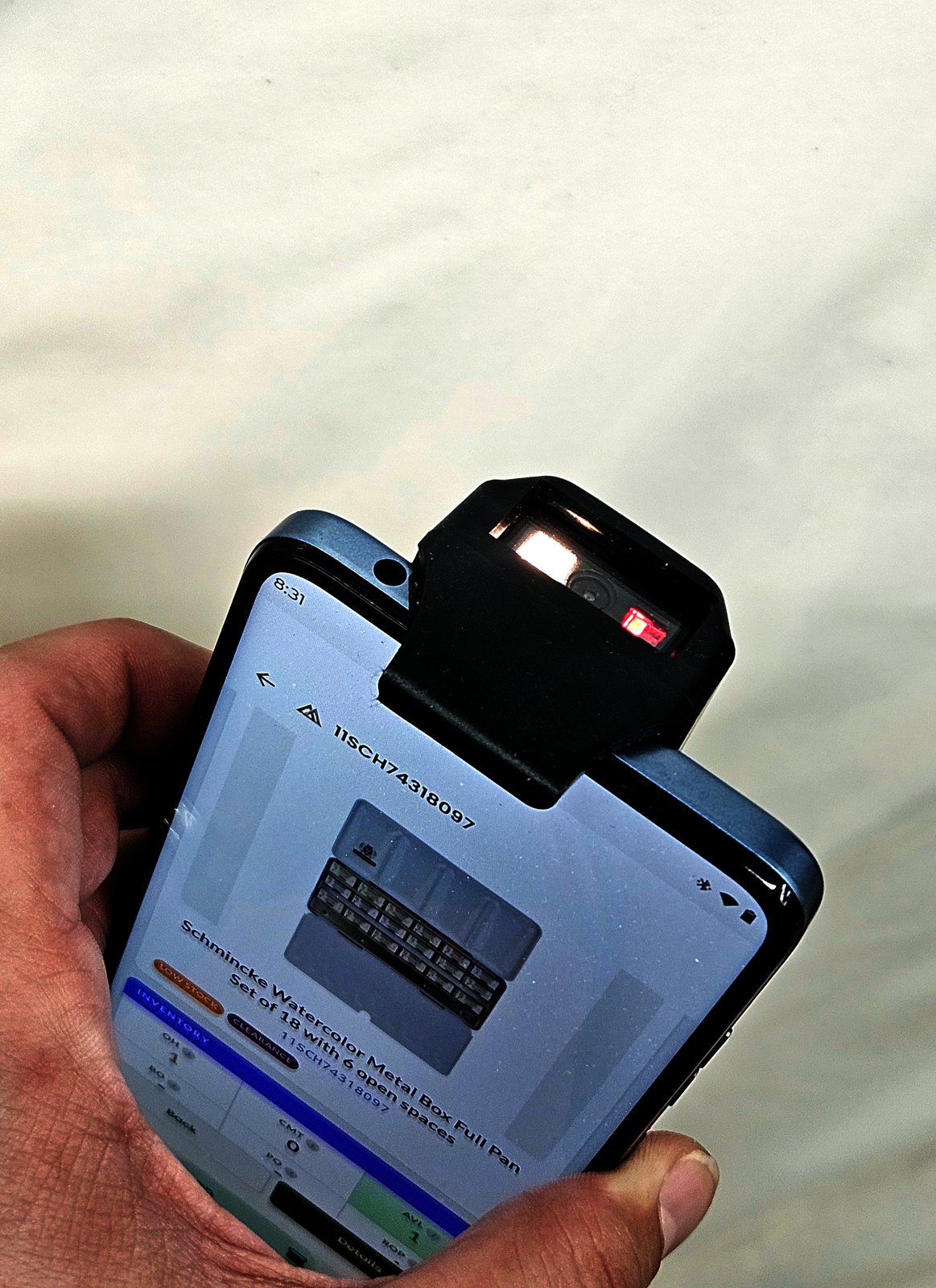
Staff carry a phone-sized unit — a cheap Android phone with a Bluetooth barcode scanner in a belt-loop pouch. Scan the shelf tag, scan the product barcode, and within seconds that tag shows the product's price. It persists through every sale and price change, automatically selecting the correct template. Fully integrated with the existing POS, ERP, and CRM.
No more tag printing. No adhesive label stock, no thermal ribbons, no ink cartridges to recycle. No printer queue collisions with invoices and shipping manifests. No printer contracts, no outages cascading across departments. The shared printers serve the rest of the business uninterrupted — and $15,000 a year stays in the budget.
Each tag is built to last years — realistically, decades. Dual button-cell batteries are commonly available and easily swapped by any staff member. The hardware is tough enough to survive drops and bumps on a busy retail floor. No recurring hardware costs, no planned obsolescence. Buy once.
Delta Art uses all three tag sizes. A single tag can display multiple products side by side — keeping shelf real estate optimized for smaller items like individual paint tubes or pen sets. Fewer tags, more information, cleaner shelves.
The owner designs his own tag templates with a visual drag-and-drop editor. Text, barcodes, icons, product images, data-bound fields — placed exactly where he wants them. No design agency, no ticket to a vendor. Changes go live in minutes. Regular templates, sale templates, seasonal layouts — all in his hands.
When a sale begins in the POS, tags automatically switch to the sale template — showing sale prices, sale dates, and distinct visual elements that catch the eye. When the sale ends, they switch back. No manual work. The system knows what's on sale and renders accordingly, in real time.
No more paper labels going to landfill after every price change. No ink cartridges or laser toners to recycle. No plastic adhesive backings thrown away immediately after peeling. Tags that last decades replace a cycle of print-stick-peel-discard that repeats thousands of times a year. For a store full of artists, that matters.
Every tag has a built-in RGB LED. A future phase enables a customer-facing mobile feature: a shopper searches for a product and the tag lights up on the shelf. “Just find the blinking light.” It positions the retailer as genuinely forward-thinking, makes the store easier to navigate, and sets Delta Art apart from every competitor in the market. The hardware is already installed — it's a software update away.
The $35,000 isn't just a line item that disappeared — it's a person who got promoted. The staff member who spent every day printing, sorting, and sticking labels is now on the sales floor helping customers and actively driving revenue. That's not a cost cut; it's a reinvestment in the business.
The other $15,000 vanished from the consumables budget: specialty adhesive label stock, branded tag paper, thermal ribbons, ink, printer maintenance contracts, and the operational disruptions when shared printers went down. No more misprinted custom stock going in the bin. No more printer queue collisions holding up invoices and shipping.
The industry-standard ESL payback period is 18–24 months. Delta Art hit full ROI in six. The investment pays for itself twice over in the first year, and the tags are built to last for decades. No subscriptions. No recurring fees. The hardware is the product.
“We had one person doing nothing but price tags, full time. Every sale was a nightmare — tens of thousands of products to re-tag, and we'd still miss hundreds. Customers would come to the register expecting the sale price and we'd have to honour it. Now I click one button and every tag on the floor updates. That person? She's on the sales floor now, helping customers. She got promoted because the tags freed her up to do real work.”
“I looked for an established vendor. I wanted one! But nobody could do this for under a quarter million, and they all wanted my data in their cloud. This thing runs right here in my store — it's a cloud in a box. Even when the internet goes down, my tags keep working. The tags paid for themselves in six months. And the shelves look better than they ever have.”
Quotes are representative of conversations with the Delta Art owner. Final attribution pending approval.
Delta Art went from a full-time tag employee and $15K in annual printing costs to zero consumables, a promoted team member, and shelves that sell themselves — with every byte of data staying in-house. Book a demo to see how the math works for your operation.